
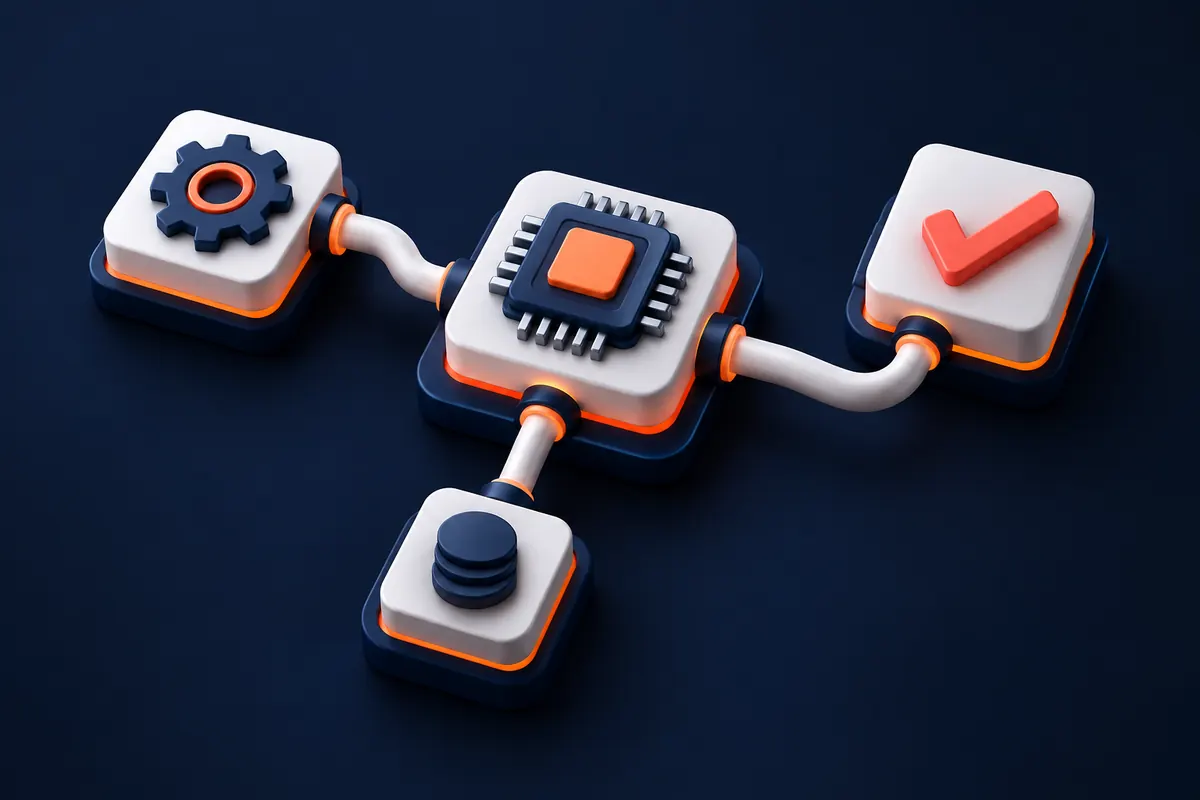
An AI assistant and workflow automation are not interchangeable solutions. The assistant suits conversation, knowledge access and preparing actions; a workflow is stronger when the process has clear triggers, rules and system actions.
Choose an AI assistant when the user needs to ask questions, navigate knowledge or get personalized help. Choose workflow automation when the process is event-driven and has to execute actions reliably. For many business processes the best solution is a hybrid: AI understands the unstructured input, and a deterministic workflow controls the actions.
The assistant is an interface, the workflow is a process
A chat interface can create a sense of intelligence, but the value comes from what happens after the conversation. If the assistant has to create a CRM task, check inventory or prepare a document, reliable orchestration logic is needed behind it.
When an AI assistant is a good choice
- Knowledge-base Q&A;
- customer self-service with clear boundaries;
- sales discovery and qualification support;
- an internal copilot for procedures and documents;
- drafting and summarization with human review.
When workflow automation is better
- sync between CRM, ERP and forms;
- routing by clear rules;
- scheduled reporting;
- status-based notifications;
- data normalization and enrichment;
- repeatable approvals and handoffs.
The hybrid model
A typical strong pattern is: a webhook receives an inquiry → AI extracts intent and entities → schema validation → deterministic routing → CRM write → human approval in a high-risk case. This way the model does what it is good at, and the system logic stays controllable.
Risk determines autonomy
| Action | Risk | Approach |
|---|---|---|
| Tag / summarize | Low | Automatic |
| Draft email | Medium | AI + review |
| Refund / contract | High | Human approval |
| Knowledge answer | Depends on the domain | Sources + boundaries |
Do not choose the model before the architecture
OpenAI, Gemini, Claude or another model can be the backend depending on the specific task. The business architecture has to be model-agnostic: inputs, controls, audit trail and fallback should not depend on a single vendor solution.
How to decide
- Describe the process without AI terminology.
- Mark the deterministic and ambiguous steps.
- Define the read and write actions.
- Assess the consequence of error.
- Add validation and human control.
- Choose the interface: chat, form, background workflow or a combination.
For production orchestration, see n8n automation in production.
Not every process needs a chatbot, and not every chatbot needs autonomous actions. The architecture should follow the task, not the AI fashion.
If you already know which process you want to automate, see how to evaluate an AI automation agency on access, testing and maintenance.

